
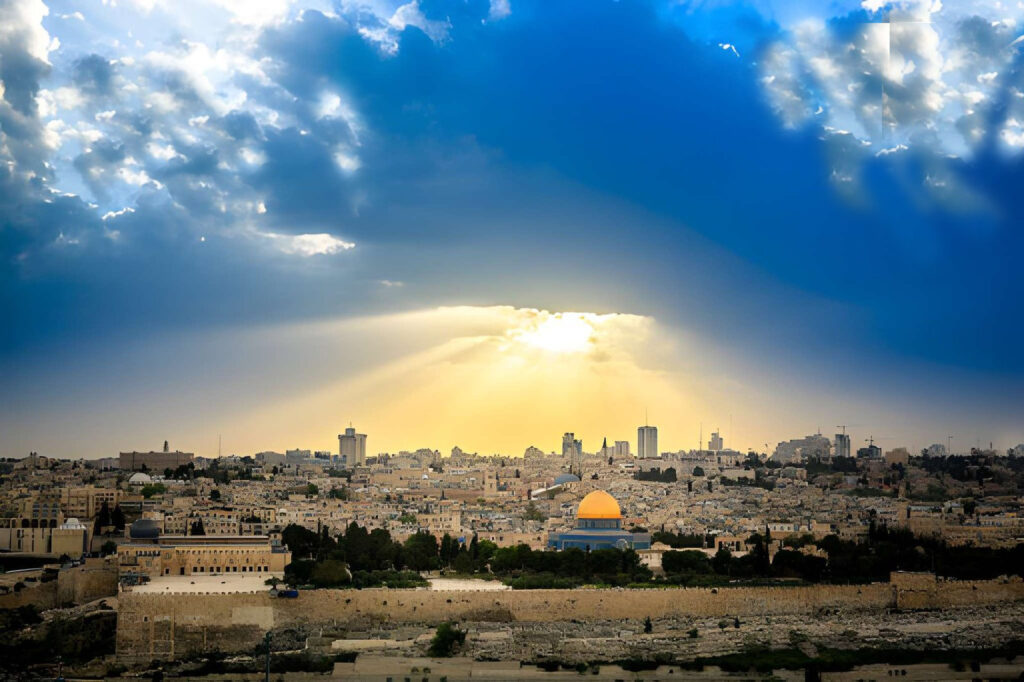
Jerusalem is a city with one of the longest and most turbulent histories in the world. Attacked 52 times, besieged 23 times, captured and recaptured 44 times, and destroyed twice, it has been a battlefield for thousands of years. Settled as far back as the 4th millennium BCE, Jerusalem is not just ancient; it is sacred, contested, and repeatedly drawn into wars. This ancient Jerusalem conflict is at the very heart of the wars we see today.
Located in present-day Israel, Jerusalem is considered by many as one of the holiest places on earth. This importance lies in its spiritual weight. For the three largest Abrahamic religions in the world, Judaism, Christianity, and Islam, Jerusalem is holy ground. That shared reverence has ensured that every empire, every conqueror, and every modern nation that touches it becomes entangled in conflict.
The modern Israeli-Palestinian conflict is a stark example of this cycle. Extending from the twentieth century into the opening decades of the twenty-first, the conflict has developed far beyond a local territorial dispute, drawing sustained involvement from global powers such as the United States and Russia, regional powers such as Iran, and numerous governments across the Middle East and beyond.
is it best to add ‘the’ at the begining of this..
Early History of Jerusalem
According to archaeological consensus, the story of Jerusalem begins in the Chalcolithic and Early Bronze Age, several millennia BCE, when the first human settlements emerged near the Gihon Spring. Over the next two millennia, that settlement developed into a fortified Canaanite city, which the Bible associates with the Jebusites and refers to as Jebus.
Everything changed around 1000 BCE. According to the biblical account, King David of Israel conquered the fortified city, renamed it the City of David, and declared it the capital of his kingdom, the United Monarchy of Israel and Judah. Biblical tradition describes David as envisioning a permanent spiritual home for the Ark of the Covenant within the city’s walls. However, a lifetime of relentless warfare prevented him from realizing this dream. The construction of the Holy Temple was ultimately left to his son and successor, King Solomon.
Renowned for his wisdom and wealth, Solomon mobilized vast resources to complete the First Temple in Jerusalem approximately 40 years later, in the tenth century BCE.. Enormous blocks of high-grade limestone were cut and meticulously shaped at the mountain quarry before being transported to Mount Moriah. These stones were used to construct the temple from the ground up. Massive cedar and pine trees were felled in Lebanon and floated down the coast by sea. This highly prized wood was used to line the entire interior walls and ceilings, completely concealing the stone underneath. Fleets of ships arrived from the wealthy, mysterious port of Ophir, bringing solid gold of the finest quality. The interior floors, walls, and inner sanctuary of the temple were heavily overlaid with this treasure. The end result was a magnificent temple of immense proportions that appeared to have been built entirely from pure, solid gold.
While the exterior was built of massive quarried limestone, the interior was so heavily overlaid with gold leaf that visitors felt they were standing inside a solid gold mountain.
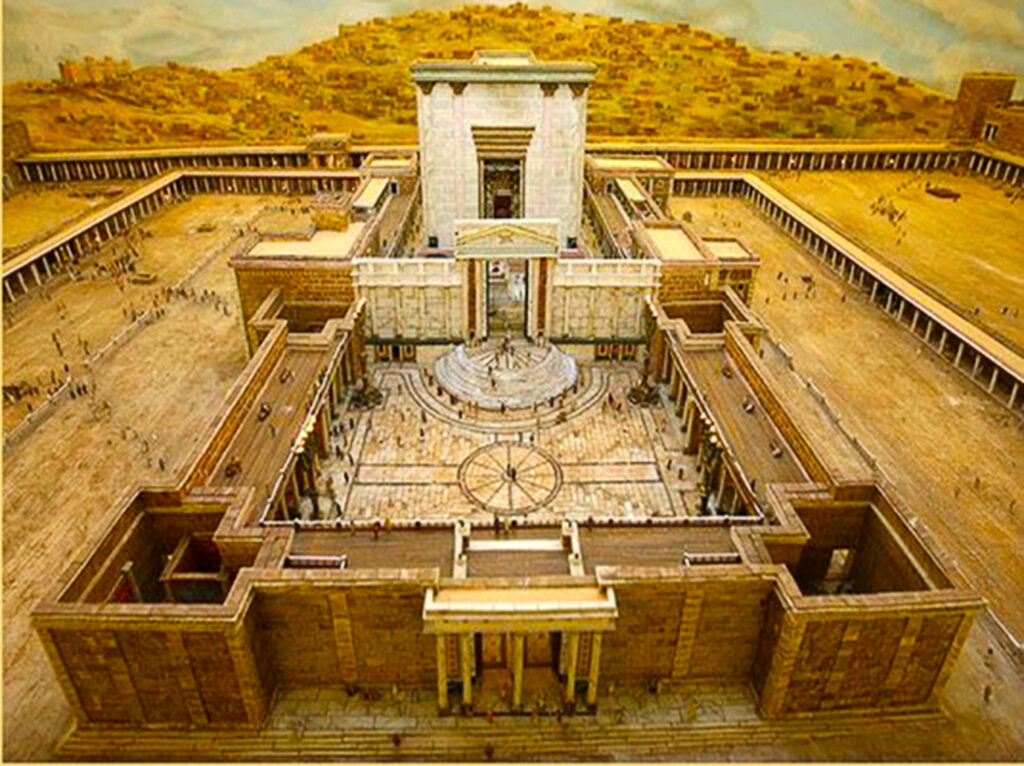
This monumental achievement transformed Jerusalem from a political capital into the spiritual epicenter of the Jewish world.
The exact location of Ophir, the wealthy port that supplied such a vast amount of gold for Solomon’s Temple, has long mystified historians. Many scholars place it in present-day Saudi Arabia, while others point to Ethiopia. This unsolved mystery is precisely what gave birth to the legend of King Solomon’s mines.
This golden era came to a devastating end in 586 BCE. The powerful Babylonian Empire, led by King Nebuchadnezzar II, invaded the region, besieged Jerusalem, and reduced Solomon’s Temple to ashes. The city was plundered, and the majority of the Jewish population was forced into exile in Babylon.
Yet Jerusalem’s story did not end in the ashes. Decades later, the geopolitical tides shifted. On October 12, 539 BCE, the advanced forces of King Cyrus the Great, led by his general Ugbaru, entered Babylon without a major battle after outmaneuvering the Babylonian army upstream. With this, Cyrus conquered the Babylonian Empire.
In 538 BCE, a year after the conquest, Persian policy permitted many displaced peoples to return to their homelands. According to the biblical books of Ezra and Chronicles, Cyrus issued an edict authorizing the Jewish exiles to return to their ancestral land and rebuild their sanctuary in Jerusalem.
Driven by faith, the returning exiles began clearing the rubble to rebuild their sacred sanctuary, laying the foundation stones for the Second Temple and inaugurating the Second Temple era.
From the Greeks to the British Mandate
The Persian Empire—specifically the Achaemenid Empire, the first of the Persian dynasties—ruled Jerusalem and the surrounding region for nearly two hundred years. This era of stability lasted until the reign of King Darius III, when a new power came marching into the land.
After laying waste to the cities of Tyre and Gaza, the forces of Alexander the Great swept through the region in 332 BCE, and the inhabitants of Jerusalem welcomed them without a fight.
Following Alexander’s untimely death, the empire fractured, and control of Jerusalem shifted between his rival Greek generals—the Ptolemaic dynasty in Egypt and the Seleucid Empire in Syria.
The Maccabean Revolt against Seleucid rule eventually produced an independent Jewish state governed by the Hasmonean dynasty. In 63 BCE, however, the Roman Republic under Pompey captured Jerusalem and brought the city into Rome’s expanding sphere of control, fundamentally reshaping its destiny.
Initially, the Romans chose not to rule directly. In 40 BCE, the Roman Senate bestowed upon King Herod the Great the official title “King of the Judeans,” establishing him as what historians call a “client king.” Under this arrangement, Herod did not govern an independent nation; he had to answer directly to Rome, pay heavy tributes to the empire, and provide vital military support to Roman authorities like Mark Antony and, later, the Emperor Augustus. This subservient alliance with Rome deeply angered his Jewish subjects. To appease them and secure political favor, Herod embarked on a monumental project in 20 BCE to completely reconstruct and expand the Second Temple, turning the Temple Mount into an architectural marvel.
Over the next two millennia, Jerusalem became the ultimate geopolitical prize. It was attacked, conquered, and traded among a relentless succession of empires. The city passed through the hands of numerous powers, including the Romans and Byzantines, a brief period of Sasanian Persian control, the Rashidun, Umayyad, Abbasid and Fatimid caliphates, the Seljuks, the Crusaders, the Ayyubids, and the Mamluks. In 1517, Jerusalem became part of the Ottoman Empire, which governed it and much of the Middle East until 1917.
This historic cycle of foreign rule culminated during World War I with the collapse of the Ottoman Empire. On December 9, 1917, the Ottoman garrison evacuated Jerusalem, and the local mayor officially surrendered the city to British troops. The events of the following three decades laid the groundwork for the regional wars still being witnessed today.
A Critical Decision by the British
Following Britain’s capture of Jerusalem in December 1917, the city was initially governed under military administration. A civil administration was established in Palestine in 1920, and British rule was formalized through the League of Nations Mandate for Palestine in 1923. Britain continued to administer Jerusalem and the surrounding territory for nearly three decades.
During this Mandate period, competing Arab and Jewish nationalist movements, large‑scale immigration, disputes over land and political authority, and recurring outbreaks of violence placed mounting pressure on the British administration. By the end of World War II, Britain was actively seeking to end its responsibility for the territory.
In November 1947, the United Nations General Assembly adopted Resolution 181, recommending the partition of Mandatory Palestine into Jewish and Arab states while proposing that Jerusalem be placed under a special international regime. Intensifying clashes between Arab and Jewish communities strained British resources, ensuring the proposal was never fully implemented as the Mandate drew to a close.
On Friday, May 14, 1948, as Britain completed its withdrawal and prepared to terminate the Mandate, Jewish leaders proclaimed independence and the establishment of the State of Israel. Fighting between Arab and Jewish forces had already been underway for months, but the conflict entered a new phase. Neighboring Arab armies joined the war on the side of the Palestinians following the official end of the British Mandate.
Rather than an intentional British partition, the brutal reality of the war itself physically divided the city. Following the 1949 ceasefire agreements, a fortified military line separated Jerusalem for nearly two decades: Israel controlled West Jerusalem, while Jordan controlled East Jerusalem, including the historic Old City.
This tense division ended during the Six‑Day War of June 1967. Amid escalating regional tensions, Israel launched preemptive strikes against Egypt on June 5. Jordan subsequently entered the conflict, and Israeli forces captured East Jerusalem and the West Bank. Israel extended its law, jurisdiction, and administration to East Jerusalem and later declared Jerusalem its unified capital.
Israel considers the city its undivided capital, while the United Nations and most of the international community do not recognize Israeli sovereignty over East Jerusalem, leaving the city’s final political status deeply contested.
Also Read: The Secret Society and Plice Force that Murdered Hundreds in a British Colony in Africa
Important Milestones in the Early History of Jerusalem
Beyond its overarching wars, Jerusalem’s timeline is defined by historic milestones that fundamentally reshaped world religion and geography:
- Herod’s Grand Reconstruction: Around 20–19 BCE, King Herod the Great, ruler of Jerusalem and Judea, began an enormous reconstruction and expansion of the Second Temple complex. He greatly enlarged the Temple Mount platform and constructed massive retaining walls, portions of which survive today, including the Western Wall.
- The Crucifixion of Jesus: In the early first century CE, most commonly dated to around 30 or 33 CE, a man known as Jesus of Nazareth was crucified under Roman authority in Jerusalem. According to Christian belief, his subsequent resurrection transformed Jerusalem into one of the central sacred cities of Christianity.
- The Siege and Destruction: Following a major Jewish rebellion in 70 CE, Roman legions under Titus swept through the city and completely destroyed the Second Temple. This catastrophic event, along with the scattering of the Jewish population into foreign lands, adding to those already exiled after earlier wars, profoundly reshaped the course of Judaism.
- The Arrival of Islam (621–638 CE): According to Islamic tradition, around 621 CE the Prophet Muhammad experienced his miraculous Night Journey, ascending to heaven from the sacred rock where the Jewish Temple once stood. Following his death in 632 CE, Islamic forces captured Jerusalem in 637–638 CE. Over the following centuries, its association with the Night Journey and the sacred compound of Haram al‑Sharif established Jerusalem as one of Islam’s holiest cities, traditionally ranked after Mecca and Medina.
- The Dawn of Pilgrimage (4th Century CE): Following the conversion of the Roman Empire to Christianity, the 4th century sparked an era of massive European Christian pilgrimages to Jerusalem, leading to the construction of major holy landmarks.
- The Crusader Era (1099–1187 CE): After centuries of Islamic governance, European Christian Crusaders launched military campaigns to capture the city. They breached the walls in 1099, establishing the Kingdom of Jerusalem, until the Muslim general Saladin recaptured the city in 1187.
The Temple Mount: The Epicenter of Faith and Conflict
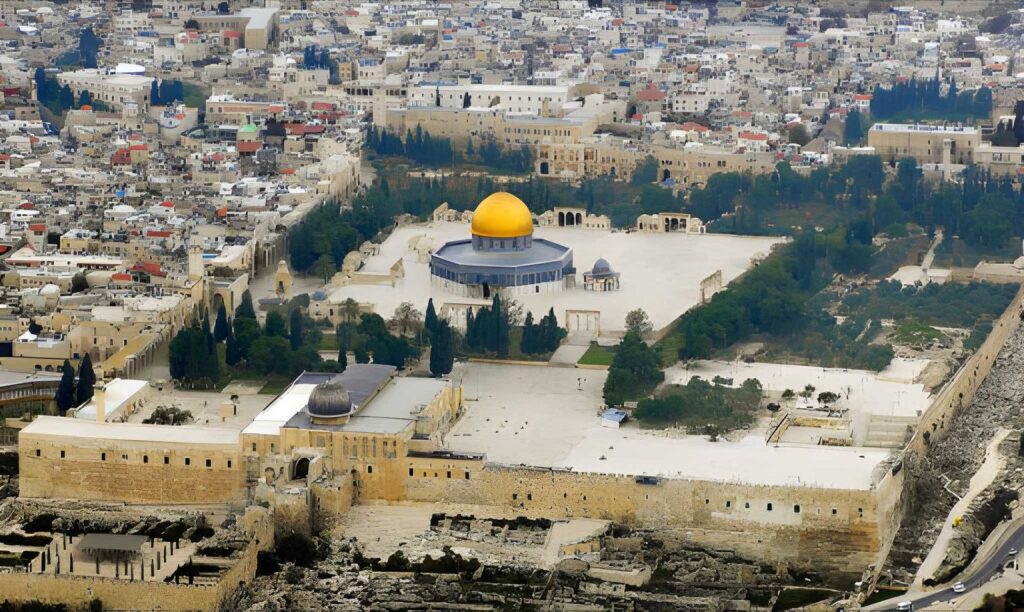
For many outside the region, the name may be unfamiliar, yet this single location is the core spiritual catalyst behind centuries of struggle over Jerusalem. Known to Jews as Har HaBayit (The Temple Mount) and to Muslims as Haram al-Sharif (The Noble Sanctuary), this 35-acre elevated compound in the Old City holds unparalleled religious significance. The site encompasses iconic structures including The golden Dome of the Rock and the Al-Aqsa Mosque, while its massive western retaining wall serves as Judaism’s premier place of prayer.
The Jewish Connection: The Holiest Site on Earth
For Jews, the Temple Mount is the absolute holiest site in existence. Jewish tradition identifies the hill as Mount Moriah, the sacred ground where Abraham bound his son Isaac for sacrifice, an event also recounted in the Bible book of Genesis. It is the historical location of both the First Temple built by King Solomon and the Second Temple expanded by King Herod. Rabbinic tradition holds that this is the spot where the creation of the world began and where the Divine Presence rests most intensely. This makes the mount central to Jewish religious memory, prayer, and hopes associated with Jerusalem.
The Islamic Connection: The Noble Sanctuary
To Muslims worldwide, Haram al-Sharif is one of Islam’s holiest sites, traditionally ranked third after Mecca and Medina. Islamic tradition identifies the compound with al-Masjid al-Aqsa, the “Farthest Mosque” mentioned in the Qur’an. It is the sacred location associated with the Prophet Muhammad’s Night Journey and Ascension.
Islamic tradition also associates Abraham with the sacred landscape of Jerusalem. In the Qur’anic account of Abraham’s attempted sacrifice of his son, the son is not named explicitly. Later Islamic tradition predominantly identified him as Ishmael, Abraham’s firstborn through Hagar, who is traditionally recognized as the ancestor of the Arab peoples. This contrasts with the biblical account and Jewish tradition, which identify the son as Isaac, ancestor of the Jews.
The Christian Connection: Footsteps of Jesus
Christians view the Temple Mount with profound historical and biblical reverence. The Temple features prominently in both the Old Testament and the New Testament. According to the Gospels, Jesus was presented at the Temple as a child, later taught there, and confronted merchants and money changers operating within the Temple precincts.
A Tense Modern Balance
Because of these overlapping holy claims, control of the compound has sparked bitter geopolitical conflict for centuries. Following Israel’s capture of the Old City in 1967, Israel assumed overall security control of the site. To prevent a major religious war, however, a delicate status quo was established: Israeli security forces manage external access and security, while the Jordanian-supported Islamic Waqf continued to administer the compound’s Muslim religious institutions. Under the longstanding status quo, Muslims worship at the site, while non-Muslims may visit during designated periods but are officially restricted from conducting public prayer. In recent years, however, enforcement of these arrangements has become increasingly contested, with instances of Jewish prayer at the compound prompting renewed disputes over whether the traditional status quo is being altered.
The Three Major Religious Centers in Jerusalem
Within Jerusalem, sacred sites associated with the three major Abrahamic religions, Judaism, Christianity, and Islam, lie remarkably close to one another.
The Dome of the Rock: An Islamic Masterpiece
Dominating the Jerusalem skyline, the Dome of the Rock is an iconic, gold-domed Islamic shrine built atop the elevated platform of the Temple Mount. Completed in 691 CE under the Umayyad Caliph Abd al-Malik, this monumental structure was intentionally erected over the Foundation Stone. Muslims believe this is the spot where the Prophet Muhammad ascended to heaven, and it is also where the ancient Jewish Temples once stood. Today, it remains celebrated as one of the earliest surviving major monuments of Islamic architecture.

The shrine’s history mirrors the turbulent tug-of-war for the city. After European Crusaders captured Jerusalem in 1099, the Dome of the Rock was converted into a Christian church known as the Templum Domini (Temple of the Lord). This transformation was short-lived. In 1187, the Muslim general Saladin recaptured Jerusalem, removed the Christian symbols, and restored the structure to its original status as an Islamic shrine.
Sitting just a short distance away on the southern side of the compound is the Al-Aqsa Mosque. Earlier structures on the site date back to the early Islamic period (between 638 and 705 CE), although the building underwent major reconstruction following earthquakes. During Crusader rule, the complex was used first by the rulers of the Kingdom of Jerusalem and later by the Knights Templar. After Saladin recaptured Jerusalem in 1187, it was restored to Muslim worship.
The Western Wall: Judaism’s Sacred Anchor
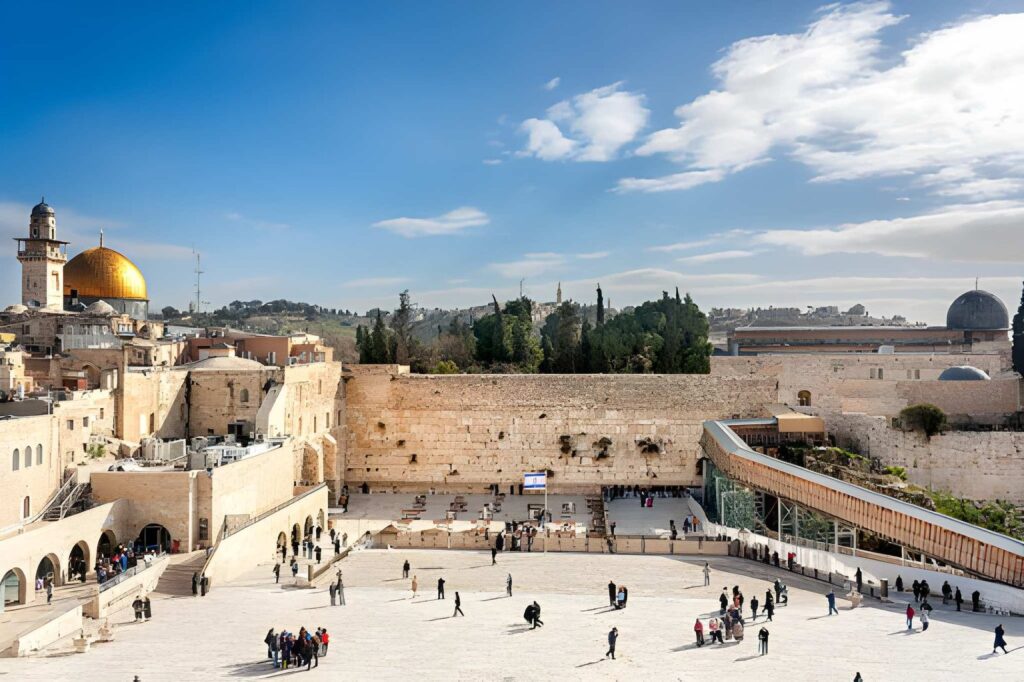
The Western Wall, historically referred to as the Wailing Wall, is a massive limestone structure located on the western flank of the Temple Mount. Rather than being a surviving wall of the Temple sanctuary itself, the Western Wall formed part of the retaining system built during Herod the Great’s expansion of the Temple Mount platform.
For centuries, outsiders called it the Wailing Wall because of the profound, tearful prayers of Jewish pilgrims mourning the destruction of their holy sanctuary.
Today, millions of visitors from across the globe journey to this open‑air synagogue each year.

Because the Islamic religious institutions on the Temple Mount plateau are administered by the Jordanian‑supported Waqf, and the compound remains subject to sensitive religious arrangements, public Jewish prayer there is officially restricted. The Western Wall has consequently become Judaism’s most important accessible public prayer site adjacent to the Mount. Jewish worshippers gather there for prayer, ceremonies, and the long‑standing practice of placing written petitions into the cracks between the ancient stones.
The Church of the Holy Sepulchre: The Christian Heartland
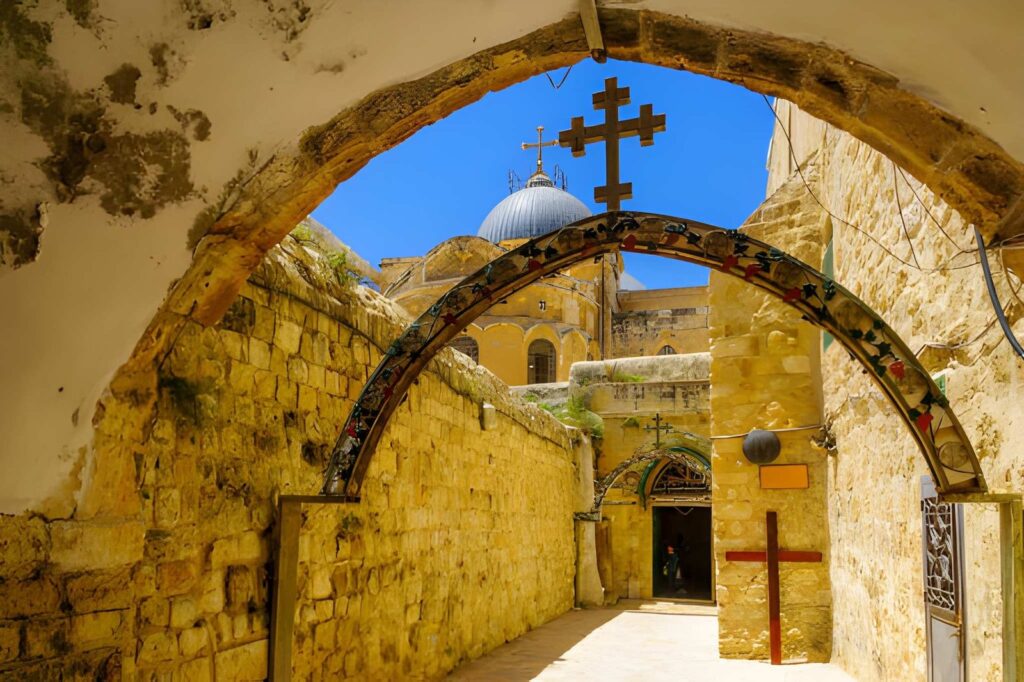
Nestled deep within the bustling Christian Quarter of Jerusalem’s Old City lies the Church of the Holy Sepulchre. First commissioned and dedicated in 335 CE by the Roman Emperor Constantine the Great, this ancient complex is the epicenter of the Christian world. According to centuries of Christian tradition, the church encompasses the two most sacred sites in the faith: the hill of Calvary (Golgotha), where Jesus of Nazareth was crucified, and the rock-cut tomb where he was buried and subsequently resurrected.
Every year, hundreds of thousands of Christian pilgrims belonging to various denominations, including the Eastern Orthodox, Roman Catholic, Armenian Apostolic, Coptic, Syriac, and Ethiopian churches, visit the Church of the Holy Sepulchre.
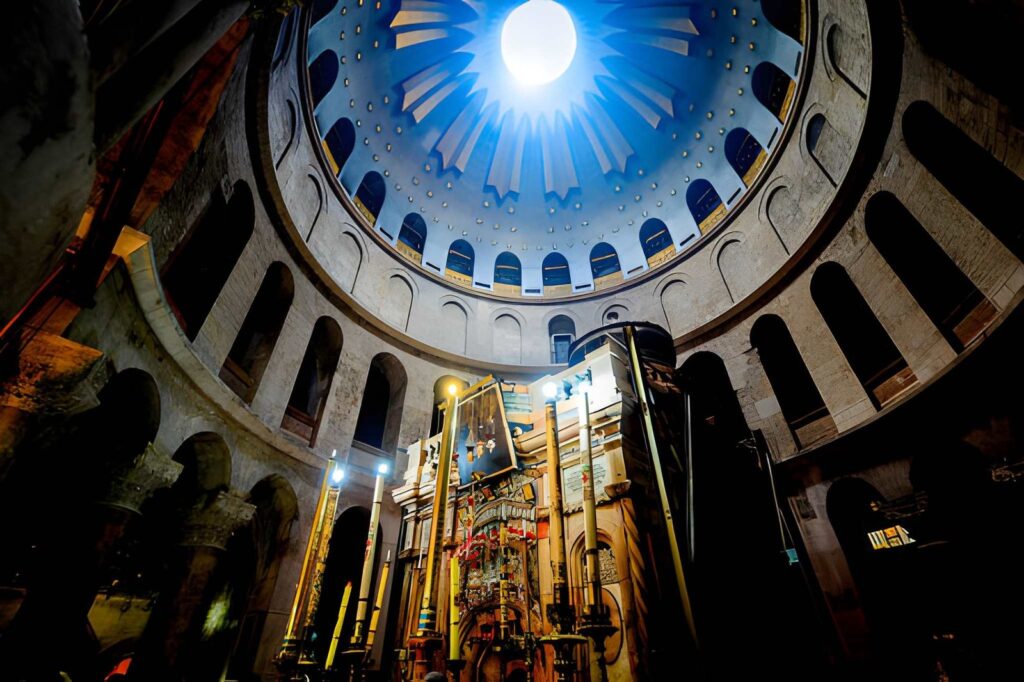
For many Christians, pilgrimage to the church represents one of the most significant spiritual journeys associated with the life, death, and resurrection of Jesus.
The Israeli-Palestinian Conflict In the 21 Century
Since the establishment of Israel in 1948, Jerusalem has remained a recurring focus of Israeli-Palestinian political and religious tension. Many Orthodox Jewish religious authorities have historically discouraged or prohibited entry to the Temple Mount because of concerns about entering areas once occupied by the ancient Temple’s most sacred precincts. Other Jewish religious authorities permit carefully restricted visits. Israeli police regularly escort groups of Jewish and other non-Muslim visitors to the compound, a practice closely watched by Palestinian and Muslim authorities concerned about possible changes to the longstanding status quo.
One of the most significant modern flashpoints occurred in September 2000, when Israeli opposition leader Ariel Sharon visited the Temple Mount/Haram al-Sharif under heavy security. The visit provoked widespread Palestinian anger and was followed by demonstrations and escalating violence that developed into the Second Intifada, although the uprising also reflected broader political tensions that had been building for years. Sharon later became Israel’s Prime Minister.
In the decade that followed, the geopolitical stakes grew even higher. Some Jewish religious-nationalist organizations increasingly advocated expanded Jewish access and prayer rights on the Temple Mount, while a smaller number openly promoted the eventual construction of a Third Temple. Such proposals have generated intense concern across the Muslim world, while the continuous political efforts to cement Jerusalem exclusively as Israel’s capital added further fuel to the fire.
Palestinian leaders, meanwhile, have consistently maintained that East Jerusalem should serve as the capital of a future Palestinian state. The overlap between Israeli and Palestinian national claims, combined with the city’s religious significance, has made Jerusalem one of the most difficult issues in peace negotiations.
The Jerusalem Conflict Never Ends
Despite repeated international and regional peace initiatives, tensions in Jerusalem remained high throughout the opening decades of the twenty-first century. Periodic confrontations between Israeli security forces and Palestinians continued, particularly around politically and religiously sensitive locations.
Much of the international community continued to support a negotiated two-state solution in which Jerusalem’s final status would be determined through agreement between Israelis and Palestinians. Numerous peace proposals have envisioned Jerusalem serving in some form as the capital of both states, although no mutually accepted arrangement has yet been achieved.
On July 14, 2017, three Palestinian citizens of Israel opened fire near the Temple Mount/Haram al-Sharif compound, killing two Israeli police officers before the attackers themselves were killed by Israeli security forces. Israeli authorities subsequently closed the compound, including to Muslim Friday prayers, reportedly the first complete closure of its kind since 1969. New security measures introduced after the attack sparked major Palestinian protests and a wider regional crisis.
The Geopolitical Shift and the Embassy Domino Effect
For decades, most governments avoided formally recognizing exclusive Israeli sovereignty over all of Jerusalem, maintaining that the city’s final political status should be settled through negotiation. After Israel adopted its 1980 Basic Law declaring Jerusalem its complete and united capital, the United Nations Security Council Resolution 478 rejected measures intended to alter the city’s status and called upon states that had established diplomatic missions in Jerusalem to withdraw them.
By 2006, El Salvador and Costa Rica were the last two countries to relocate their embassies from Jerusalem to the Tel Aviv area. Some governments, including the United States, Britain, and France, continued to maintain separate diplomatic or consular missions in Jerusalem.
In May 2017, Hamas issued a new political document stating that the establishment of a fully sovereign Palestinian state along the pre-1967 lines, with Jerusalem as its capital, could constitute a formula of national consensus. However, the document did not recognize the State of Israel or abandon Hamas’s broader claims to historic Palestine. The Israeli government dismissed the proposal.
America Takes a Firm Stand on Jerusalem
For decades, the United States maintained its embassy in the Tel Aviv area, west of Jerusalem, while operating a separate diplomatic consulate in Jerusalem.
In 1989, the Israeli government initiated a 99-year lease of a plot of land in Jerusalem to the United States at a cost of $1 per year. This land was specifically designated as the future site of a new U.S. Embassy, but it remained undeveloped for nearly thirty years.
Although the US Congress passed the Jerusalem Embassy Act in 1995, successive U.S. presidents repeatedly used the law’s national-security waiver to postpone relocating the embassy. Presidents Bill Clinton, George W. Bush, and Barack Obama regularly exercised this waiver, and President Donald Trump initially did the same after taking office in January 2017.
On December 6, 2017, fulfilling a cornerstone campaign promise, Trump changed U.S. policy by formally recognizing Jerusalem as Israel’s capital and ordering preparations to relocate the embassy. The announcement immediately reshaped American foreign policy in the Middle East.
The Rage and Conflicts That Followed
The announcement drew a swift and fierce response across the Arab world in the form of mass demonstrations and urgent calls for a new uprising against both Israel and the United States.
Jerusalem itself was thrown into immediate unrest. In the days following the declaration, violent clashes erupted between Israeli security forces and Palestinian protesters across the city. Demonstrators burned Israeli and American flags and stamped on posters of Trump in widespread displays of anger. Skirmishes quickly spread along the Gaza-Israel border, where security forces fired upon stone-throwing crowds. Fatalities and hundreds of severe injuries were rapidly confirmed.
In the West Bank, following a call for a mass general strike, protesters torched barricades of tires, sending thick columns of black smoke rising over the skylines of Ramallah and Bethlehem.
Numerous Arab and Muslim-majority governments strongly condemned the U.S. decision, describing it as a major departure from established diplomatic practice and arguing that it favored Israel’s position in one of the conflict’s most sensitive disputes.
Palestinian political factions immediately mobilized demonstrations across the West Bank, the Gaza Strip, and East Jerusalem, the historic sectors captured by Israeli forces in the 1967 Six-Day War. These three contested territories together are the land Palestinians seek as a future sovereign state, with East Jerusalem as its capital.
Leaders of Hamas promptly called for a third Palestinian Intifada against Israel, while transnational militant networks such as Al-Qaeda urged followers worldwide to target U.S., Western, and Israeli interests. In anticipation of this backlash, the U.S. government heightened security measures across its global assets.
Massive protest marches took place in cities across numerous Muslim-majority countries, including Iran, Iraq, Indonesia, Malaysia, Jordan, and Pakistan. In Amman, thousands of demonstrators filled the streets chanting, “Jerusalem is Arab” and “America is the head of the snake.”
At the Temple Mount, thousands of worshippers gathered at the Al-Aqsa Mosque to hear a stark address from their religious leadership. “All we want from the Arab and Muslim leaders is action and not statements of denunciation,” declared Sheikh Yousef Abu Sneineh to the tens of thousands gathered before him. Following the service, demonstrators filled the stone plazas of the compound, chanting: “With our soul and blood, we will defend Al-Aqsa and Jerusalem.”
America Takes Action
Despite the wave of protests and condemnations that followed U.S. President Donald Trump’s official recognition of Jerusalem as Israel’s capital, the United States stood firm. The relocation of the U.S. Embassy took place just months later, in May 2018, shattering the long-standing international consensus that Jerusalem’s status could only be decided through direct bilateral peace talks.
While the European Union and the UN strongly condemned the shift, it triggered a slow diplomatic domino effect in the years that followed. Although most countries continued to maintain their embassies outside Jerusalem, a small number followed the United States in establishing or relocating diplomatic missions to the city. By 2026, the United States, Guatemala, Honduras, Kosovo, Papua New Guinea, Paraguay, and Fiji operated embassies in Jerusalem.
Facts of the Relocation
The 1989 lease signed under President Ronald Reagan was for a plot of land known as the Allenby Barracks on Hebron Road in West Jerusalem. Building a brand‑new, high‑security embassy complex from scratch on raw land would have required years of construction and hundreds of millions of dollars. Because President Trump wanted to fulfill his campaign promise quickly, his administration bypassed that undeveloped plot to fast-track the move.
Instead of constructing a new facility, the U.S. government repurposed an existing, heavily fortified building, the U.S. Consulate General in the Arnona neighborhood of West Jerusalem, and officially redesignated it as the embassy. The embassy opened at this interim Arnona location on May 14, 2018.
The original Allenby Barracks site remained undeveloped for decades until the issue returned to prominence in July 2026, when the United States and Israel signed a new agreement concerning land for a permanent U.S. Embassy compound in Jerusalem.
Modern-Day Rivalry: The Surge in Escalation
Jerusalem today has a population exceeding one million residents. Recent demographic data indicate that approximately 60 percent of its Israeli‑resident population is Jewish and about 40 percent is Arab, with Muslims forming the large majority of the Arab population alongside a smaller Christian community. Yet these communities live within a city whose political boundaries and sovereignty remain deeply disputed. Israel exercises governmental authority throughout Jerusalem and regards the entire city as its capital, while Palestinians seek East Jerusalem as the capital of a future state. The United Nations continues to regard East Jerusalem as occupied Palestinian territory.
Tensions in and around the city remain persistent and can become highly volatile. Confrontations between Israeli security forces and Palestinian demonstrators have repeatedly attracted international attention. These flare‑ups are often ignited by highly sensitive issues, such as contested evictions of Palestinian families from East Jerusalem neighborhoods like Sheikh Jarrah, or temporary Israeli security lockdowns at the Al‑Aqsa gates during times of high tension.
This fragile environment often acts as a catalyst for wider regional warfare. In May 2021, clashes in Jerusalem, including confrontations around the Al‑Aqsa Mosque compound, contributed to a rapid escalation that developed into an 11‑day armed conflict between Israel and Palestinian militant groups in Gaza, involving extensive rocket fire into Israel and Israeli airstrikes on Gaza.
The geopolitical environment changed dramatically on October 7, 2023, when Hamas and other Palestinian armed groups launched a large‑scale attack from Gaza into southern Israel. The war in Gaza that followed produced far‑reaching humanitarian, political, and military consequences across the Middle East and intensified tensions involving regional powers. Jerusalem remained an important symbolic and political dimension of the wider Israeli‑Palestinian conflict, even as the immediate war centered primarily on Gaza and its consequences.
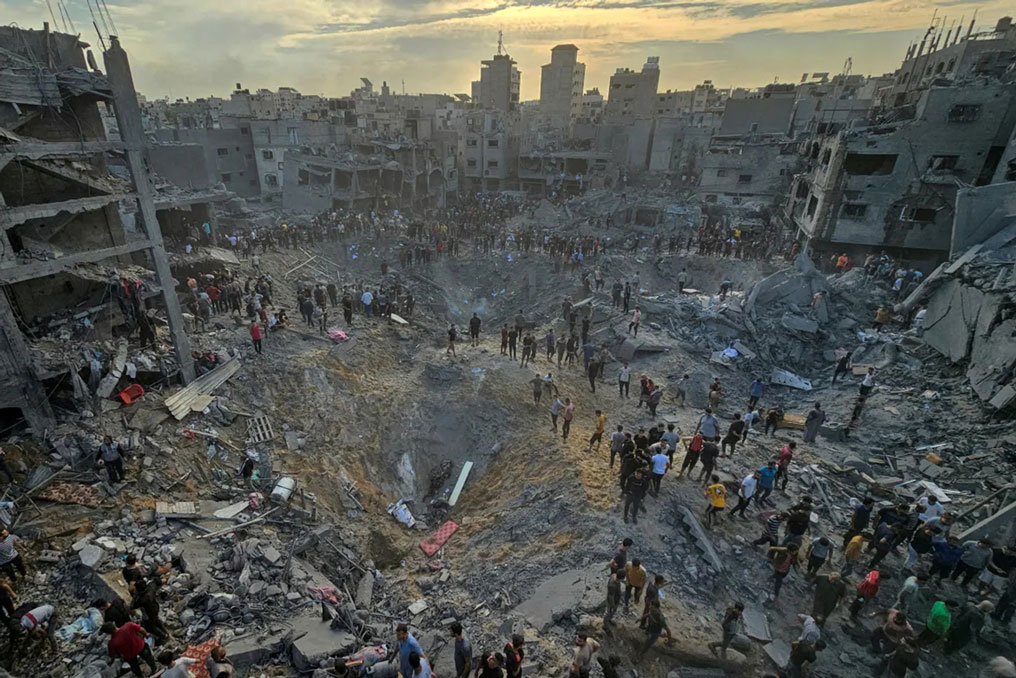
The conflict increasingly intersected with wider regional tensions involving Iran and armed groups operating from Lebanon and Yemen, while the United States and several Arab states became involved through varying combinations of military action, diplomacy, mediation, humanitarian assistance, and security measures. What began as a war centered on Gaza consequently developed into a confrontation with significant consequences across the wider Middle East.
The Core Paradox: Overlapping Spiritual and National Claims
At its deepest level, the struggle over Jerusalem combines multiple layers of claims. The dispute encompasses territory, sovereignty, national identity, security, political rights, historical memory, competing visions of statehood, and, most importantly, deeply rooted religious attachments. These dimensions converge most visibly in and around the Old City, particularly at the Temple Mount/Haram al‑Sharif.
For centuries, observers have pointed out the tragic paradox at the heart of the city’s geography: how can a single piece of land serve as the ultimate spiritual anchor for entirely different, competing theological narratives? Centuries after Roman legions destroyed the Second Jewish Temple, Islamic tradition established that the Prophet Muhammad experienced his miraculous Night Journey and ascended to heaven from that same foundation stone. In subsequent centuries, Jewish tradition identified the compound as the site of the ancient Temple, while Islamic tradition associates the sacred rock beneath the Dome of the Rock, within the same compound, as the very spot of the Prophet Muhammad’s Ascension during the Night Journey.
These deeply rooted religious traditions give the site an emotional and symbolic significance that far exceeds ordinary territorial disputes. While some historians and critics question the authenticity of these accounts, billions of believers around the world regard the theology as absolute. Because religious convictions are non‑negotiable, the overlapping claims make genuine compromise nearly impossible.
Conclusion: Who Owns Jerusalem?
Ultimately, the question of who “owns” Jerusalem yields entirely different answers depending on the lens applied:
- Israeli Perspective: Proponents of Israel’s sovereignty point to a 3,000‑year‑old Jewish connection to the land, citing King David’s establishment of the capital and the city’s association with the First and Second Temples. Israeli governments have consistently emphasized this ancient and religious connection, maintaining that Jerusalem should remain under Israeli sovereignty, though views within Israeli society differ over the city’s future boundaries and political arrangements.
- Palestinian Perspective: Palestinians emphasize generations of residence in Jerusalem, historical and cultural ties to the city, and the religious importance of Haram al-Sharif. Palestinian leaders seek East Jerusalem as the capital of a future Palestinian state. The United Nations and most of the international community regard East Jerusalem as territory occupied by Israel since 1967, a characterization rejected by the Israeli government.
Jerusalem’s name has long been associated with peace, though its ancient etymology is in fact more complex. Today, the city stands as one of the world’s most significant political and sacred landscapes. Israelis and Palestinians alike attach profound historical, national, and religious meaning to the same ancient ground, making it a deeply contested place.
Because the issues at the heart of that contest, such as control over the Temple Mount and the Old City, are so historically and religiously entrenched, the conflict over Jerusalem may well linger for generations to come. In the end, this holy city remains a beautiful yet tragic paradox: a place forever at war within itself.