
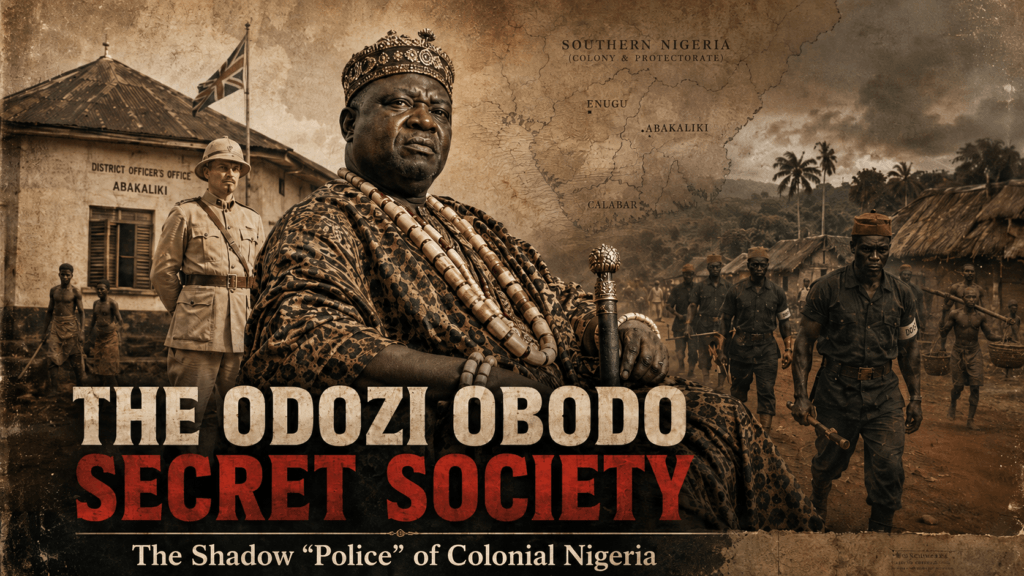
This is the story of a little-known region in a former British colony in Africa where one of the most unspeakable crimes of the 20th century unfolded. It was carried out by a secret society that operated under the full approval of the British administration.
The Land the British Could Not Rule Like the Rest
Between the fifteenth and nineteenth centuries, a steady tide of European colonial powers crashed against the shores of Africa. First came the Spanish and Portuguese, followed by the Dutch, the Belgians, and the French. The British were relatively late to the scramble, but their rule cut deeper into the African interior than almost any other empire on earth.
In West Africa, British forces conquered and stitched together a vast, sprawling territory known today as Nigeria, a land larger than France and Britain combined. It was divided into three great regions by two of Africa’s largest rivers, the Niger and the Benue. These rivers converged in the middle of the territory, then flowed hundreds of miles south to empty into the Atlantic Ocean. The north formed one massive landmass, while the south was split into two: the southwest and the highlands of the southeast. The south was blanketed by thick rainforest, while the north lay within the dry Sahel savannah belt of north-central Africa, flat lands with sparse vegetation stretching as far as the eye could see.
To the north, the British subdued the great Fulani and Hausa emirates. To the southwest, the sophisticated Yoruba kingdoms fell under the same imperial boot. But in the southeast lived a people who flatly rejected both foreign rule and the new religion of Christianity: the Igbo.
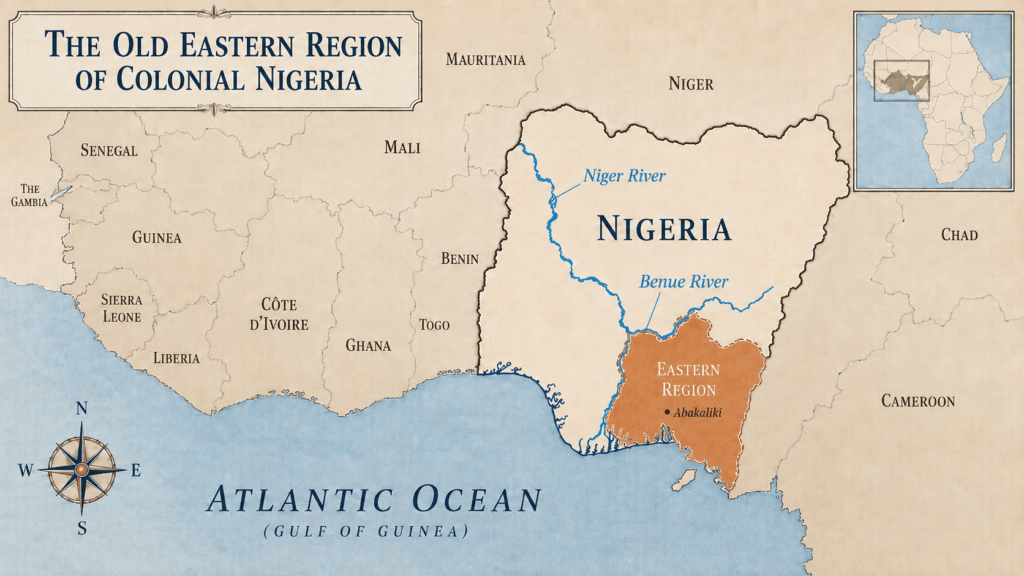
Unlike their neighbors, the Igbo were not ruled by kings. There was no single palace to capture, no central throne to topple to subdue the entire tribe. Instead, the Igbo operated on a deeply democratic, parliamentary system of government involving village councils, led by “titled men” or chiefs, individuals who earned authority not through royal bloodline but through hard work, accumulated wealth, and the respect of their communities.
Unable to conquer the Igbo by force through a single crown, the British turned to a more insidious tactic known as Indirect Rule. They selected the most powerful local chiefs and turned them into salaried agents of the British Crown. These men became the middlemen and enforcers between the empire and the population, ruling their own people in the name of the King of England.
Across most of the Southeast, this arrangement worked smoothly. But in one corner of the region, it planted the seeds of a reign of terror that lasted for about half a decade. The small towns and villages of the Ebonyi River valley lay on the remote eastern edge of the southeast, just below the mighty Benue, which marked the border with the north. This land was where, soon after the Second World War, Chief Nwiboko Obodo rose to power, along with his deadly Odozi Obodo secret society. Beginning in the small town of Abakaliki, the administrative capital of the sub-region, they terrorized and murdered people throughout the Ebonyi River lands for nearly five years.
A People Caught Between Two Identities
The Igbo were the largest tribe in southeastern Nigeria, and over the centuries they absorbed smaller, peripheral groups along their borders. Many of these lesser tribes and communities adopted dialects of the Igbo language as their native tongue and, through generations of resettlement and intermarriage, came to identify as Igbo. Yet the mainstream Igbo often treated them as second-class citizens, outsiders bearing an Igbo name, which effectively stripped them of civic rights in Igbo land.
As a result, most of these lesser tribes carried a deep resentment toward the mainstream Igbo. Nowhere was this resentment felt more sharply than in Abakaliki and the surrounding Ebonyi lands. Its people spoke a dialect of Igbo natively and were classified as Igbo by the British administration, yet they were looked down upon by the Igbo mainstream. This resentment became the fuel for the Odozi Obodo secret society, a group made up of Igbo-speaking people who harbored a deep hatred for the mainstream Igbo and acted against them whenever the opportunity arose. This hostility was what made the group so popular among the people of Abakaliki in its early years.
The Rise of Nwiboko Obodo
Nwiboko Obodo was born around 1905 in Ndubia Iseke, the son of Chief Onwe Ali Obu Ali, whose own grandfather had migrated from the town of Izhia Mgbo. His wife, Iboko Una Onwe, also came from the same town. Because the boy was born on the market day of Iboko, he was named Nwiboko Onwe, meaning “a child of Iboko.”
He was raised under the watchful eye of his uncle, Obodo Onyike, one of the wealthiest men in the region. In 1925, tragedy struck: Nwiboko’s father was murdered on his way home from settling a bitter boundary dispute between two warring villages. Nwiboko moved swiftly to claim his inheritance. He moved into his father’s compound and assumed his responsibilities in order to claim his chieftaincy title.
He had only a rudimentary education, but it was enough to set him apart from the illiterate locals in the eyes of the British authorities. He was careful in all things, calculating, and deeply charismatic. He charmed the colonial administration, and before long was appointed Paramount Chief. Backed by the authority of British guns, Nwiboko Obodo became a king-like ruler among a people who had never bowed to kings, presiding from a vast palace compound in the heart of Abakaliki.
In these early years, he was a shrewd and generous ruler who understood that power needed a foundation. He sent lavish gifts to surrounding territories. The village of Amegu, his parents’ ancestral home, once received entire cattle as a gift. He built a flawless reputation with both his people and the white district officers. In 1928, the colonial government selected him for an official delegation traveling west across the Niger to investigate crimes and tax disputes in provinces already under British administration. Nwiboko traveled to the old town of Agbor ruled by a young king, and walked the streets of the ancient kingdoms of Benin, Ife, Ibadan, and Oyo, studying firsthand how the machinery of British rule actually worked, and how a single man sitting on a throne controled millions of souls.
Back home, his influence became absolute. At the native court of Nkwegu, his word overshadowed even the other warrant chiefs of the region, men like Idike Okenwealgu, Nwiboko Udede, Idenyi Nwonu, and Mgbada Ochinta. Any colonial official or dignitary passing through Abakaliki learned quickly that a courtesy visit to Chief Nwiboko came first, or trouble would follow.
He nursed a deep hatred of the mainstream Igbo, whose numbers were growing in the region, and used his influence to ensure the colonial government never issued a Certificate of Occupancy to an Igbo man for land in his territory. Some of these lands were confiscated outright by his authority and donated to British missionaries to build infrastructure for the people of Abakaliki. This policy cemented his reputation before his people as a local patriot.
The Titan of Abakaliki
Chief Nwiboko’s hospitality was legendary. No guest left his compound hungry. A troupe of traditional dancers lived permanently on his grounds purely to entertain visitors. He paid the bride price for young men too poor to marry on their own, and those who came to beg for food often left with more yams than they could carry.
He ran a private bank inside his compound. On several occasions, when a desperate poor man came to him for help, he would tell him to take out as much money as one hand could carry.
In an era when wealth was measured in land, livestock, and labor, Nwiboko was a titan. His farmlands stretched to the horizon, worked by an army of locals, settlers, and laborers who dared not refuse him. At its peak, his herd numbered over 4,000 cattle, so large it became a menace, trampling and consuming the crops of poorer farmers, who were too afraid of the chief to complain. Whole families quietly relocated rather than fight the herd for their land.
He owned five cars—one for private use and four commercial—at a time when a single automobile was a luxury reserved for the continent’s wealthiest elites. He controlled a fleet of canoes that ferried traders across the Ebonyi River for a fee.
His domestic life was on the same scale. By his late forties, he had accumulated twenty-eight official wives and a rotating roster of concubines, with children scattered across hundreds of houses throughout and beyond Abakaliki, so many that he frequently failed to recognize his own blood. In 1954, at nearly fifty, the chief arranged to marry a fair-skinned fifteen-year-old girl, only to discover, on visiting her family to formalize things, that she was his own daughter by a forgotten concubine.
Even with his abominable flaws, the people still worshipped him, many relying heavily on his famous generosity, for he gave out like none other. They called him Nna, meaning “Father.” More than once, out of what looked like pity, he paid the tax burden of entire villages out of his own pocket, though he always found a way to collect it back later, with interest.
The British Empire’s Man in the Hinterland
His ability to collect taxes and keep the population in line made him indispensable to the colonial administration. While the “white master” was feared and resented by the people, Nwiboko drank and dined with British officials without fear. He served as the essential broker between the Crown and the surrounding towns.
He gave land for the Mile Four Hospital and its leprosy settlement, and backed Christian missionaries in building St. Nathy’s Catholic School and Izhi High School, the first secondary school in Izhiland, along with several other schools.
Having seen firsthand how education underpinned British power, he pushed his people hard to pursue it. He gave scholarships and paid school fees for many children who were not of his blood.
The Odozi Obodo Secret Society
In 1953, Chief Nwiboko founded a local security force known as the Odozi Obodo Society. It quickly stamped out crime and rebellion in Abakaliki with ruthless efficiency, earning official recognition from the British administration. From there, its jurisdiction spread to surrounding towns and villages, with real legal authority to arrest, try, and punish anyone suspected of theft or serious crime.
Chief Nwiboko’s power became total, and it corrupted him completely. He came to despise opposition and crushed dissent without mercy. He cast himself as a living god before the people and would openly boast: “Owaa Igwe, Owaa Ali, Owaa mueda bu Nwiboko Obodo; Ono ganyi haa nwere Uwa,” meaning this is the heaven, this is the earth, and this is Nwiboko Obodo, the three entities that owned the world.
He fell into the same trap that had claimed powerful men throughout history. He became drunk on power and careless with human lives.
By 1954, barely a year after its creation, the Odozi Obodo group was officially operating as a prominent and feared secret society. Chief Nwiboko Obodo went further still. He turned a branch of the Odozi Obodo into his private secret police.
From a tool of order, the Odozi Obodo became a weapon of terror. Even members used its cover to settle personal scores, and soon people across Idebya Iseke land began to vanish without a trace. Their land, wealth, and even their women were seized by Nwiboko and his loyalists.
What began as isolated disappearances grew into a massive wave of hundreds of missing persons. The rumors hardened into an open secret that could no longer be suppressed. The Odozi Obodo Society had spiraled violently out of control, and Chief Nwiboko’s reign had become synonymous with fear and blood.
Those rumors eventually reached the ears of the regional British administrator of the Southeast in Enugu in 1957. The downfall of Chief Nwiboko Obodo came swiftly.
Perhaps it is best to let a popular British news outlet of the era carry on the story, so we may read exactly how the case unfolded from those who were there, observing and reporting on every event throughout the British colony in Africa.
Below is the TIME magazine article on the case.
The Notorious Nwiboko Obodo and The Odozi Obodo Cult
Monday, Aug. 04, 1958
In the vast British tropical colony of Nigeria, the back-country people of the Southeastern Region have long been a troublesome lot for officialdom.
Mostly half-naked farmers, they take unusual delight in staging bloody campaigns against vaccinations and in setting schools on fire. Each time, the colonial police must come in to restore order. But of all the assignments that the police have undertaken, none has produced such eerie results as the search of Chief Nwiboko Obodo’s house.
For months, reports had poured in of an unusually high rate of disappearances and homicides around the small town of Abakaliki, about 51 miles from the capital of the Eastern Region, the coal-mining city of Enugu.
According to these reports, men would go to their farms in the morning and simply disappear; women went to the market and never came home. Police found evidence that since 1954 there had been more than 100 murders in Abakaliki. But it was not until they raided Chief Obodo’s house that they discovered the reason why.
Inside, they found ropes, leg irons, spears, and swords, some of them still stained with blood. They also found an assortment of juju charms within a small room that looked like a shrine dedicated to a supernatural deity, with an inscription on the wall bearing the warning that all men and women in the 14 villages around “must respect me and do whatever I say.” It soon turned out that the chief was a member of a secret cult ironically named Odozi Obodo, the “Committee of the Peacemakers.” In fact, he was the leader. This was the same man who had formed the group and once beheaded his wife with a bicycle chain to set the standard.
The most powerful arm of the society was a sort of Murder Inc. squad called Exepute, meaning “the Chief says…”
It was the Exepute that carried out the grisly justice of the society against anyone who balked at paying the “taxes” the chiefs whimsically imposed, or against those whom the chiefs merely disliked.
For the chiefs, murder was also a lucrative business: by tradition, they inherited “all property of the dead, including wives and children.”
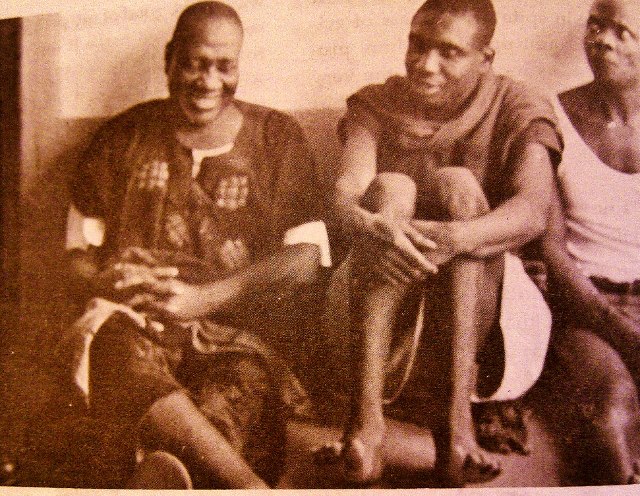
Last week, while Chief Obodo languished in jail and his British counsel, Dingle Foot (brother of Cyprus Governor Sir Hugh Foot), prepared his defense, one of his sidekicks, Chief Idaka Igboji, faced trial for murder along with ten accomplices. A steady stream of witnesses—those who dared to speak—told tales of death by drowning or being buried alive.
Finally, there unfolded the story of the specific murder in question—that of a farmer named Nwakriko Abam. Abam, according to prosecution testimony, had been invited for drinks by some of the chief’s men. Suddenly his hosts seized him and slowly strangled him with a chain. His body was then brought before Chief Igboji, dismembered, tied to the victim’s own bicycle, and flung into the river. Abam’s crime: he had had the temerity to campaign against the chief in the last local parliamentary election.
Also read: The Story of the British Colony of Palestine
What Is Left Today
Today, nearly eighty years later, the dust has settled over a transformed landscape. The small colonial outpost of Abakaliki has risen into a sprawling city, anchoring itself as the capital of Ebonyi State. Yet, as the concrete grows, history fades. The gripping saga of Chief Nwiboko Obodo and the terror of the Odozi Obodo Secret Society has slipped into the quiet corners of forgotten lore.
Look closely, and the physical footprints of that era are few. The main evidence that this land once marked the easternmost frontier of a British Colony in Africa that existed for nearly a century rests in the weathered facades of missionary schools and hospitals. Many still bear their original colonial names, standing as silent monuments to an old world order.
Beyond the new asphalt of the capital, however, the foundational realities of the past remain stubbornly unchanged. The rural heartland belongs to the farmers. In the small towns and quiet villages branching out from the city center, more than 80% of the population still lives beneath the poverty line, watching development stall at their borders.
A deeper cultural irony has also taken root. Over the decades, the local population has heavily integrated into the broader regional identity; today, most of the indigenous tribes speak fluent, mainstream Igbo. Yet language has not erased the lines of division. Within the social hierarchy of southeastern Nigeria, the people of this region are too often relegated to a second-class status, still fighting to shake off systemic marginalization from the dominant Igbo mainstream.
Abakaliki has built its future, but the ghosts of its economic and social past remain, still waiting for justice.