
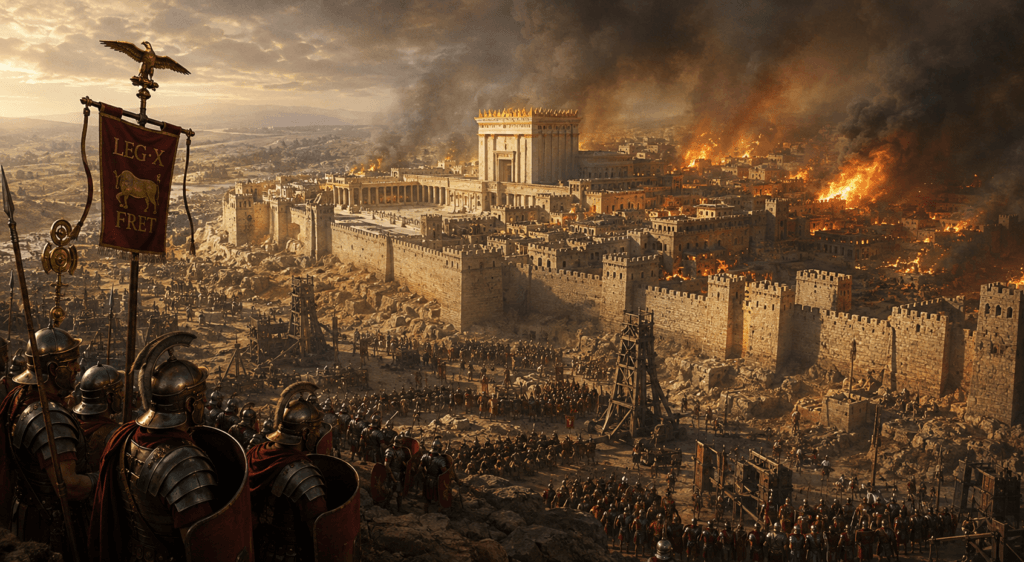
The Roman destruction of Jerusalem in 70 AD begins decades earlier, during the reign of Herod the Great, who transformed the Second Temple into one of the most magnificent architectural achievements of the ancient world. Nearly forty years after the crucifixion of Jesus Christ, this sacred city stood at the heart of a brutal conflict between Jewish rebels and the Roman Empire.
This historical narrative brings together the events, people, conflicts, and decisions that reshaped the religious and political foundations of the world more than two thousand years ago.
The Roman Legions March on Jerusalem 70 AD
The wind blowing across the Mount of Olives in the spring of 70 AD carried the scent of wild thyme, dust, and impending doom. Below the ridge, the city of Jerusalem gleamed like a mountain of snow and gold. Its crown jewel, the Second Temple, rose majestically above the colossal stone walls, its white marble reflecting the Mediterranean sun with a blinding, ethereal radiance. To the thousands of souls packed tightly within those gates, it was the literal footstool of the Almighty, an eternal house that no earthly army could ever cast down.
But on the horizon, a different kind of power was gathering. The earth trembled under the rhythmic, iron-booted march of four Roman legions: Legio V Macedonica, Legio XV Apollinaris, Legio XII Fulminata, and the feared Legio X Fretensis.
At the head of this massive war machine rode a brilliant, fiercely ambitious young general named Titus, son of the newly crowned Emperor Vespasian. Titus had a ruthless plan of his own. He had not come merely to conquer a rebellious province; he had come to erase a rebellion from the face of the earth and assert the absolute dominion of Rome over Judea.
What followed over the next five months was not just a siege, but one of the most agonizing and defining tragedies of the ancient world. It was a struggle between a people fighting for the survival of their sacred city and an empire determined to restore its authority, a story of human endurance pushed beyond the brink. The battle would end in a catastrophic fire and destruction, leaving consequences that would reshape Judaism, Christianity, Islam, and the religious landscape of the world for centuries.
The Spark that Lit the Gunpowder
The land of Judea had long been a boiling cauldron of religious passion and political resentment under the heavy hand of Roman rule. The Roman governors, or procurators, were often corrupt, arrogant, and deeply insensitive to Jewish traditions and sacred laws.
The breaking point arrived in 66 AD, under the rule of Gessius Florus. Plundering the sacred Temple treasury to pay off his own debts to Rome, Florus mocked the outraged protests of the citizens. When a group of Jewish nobles mockingly passed around a basket to collect pennies for the “poor governor,” laughter echoed through the crowded streets of Jerusalem.
Florus responded with rage. He unleashed his soldiers on the city, massacring hundreds of innocent civilians.
This was the spark that finally met gunpowder. The fury of Jerusalem could no longer be contained.
A fierce, radical group of rebels known as the Zealots rose up, overwhelming the small Roman garrison within the city. Then they went further. In a daring night raid, they captured the fortress of Masada near the Dead Sea, putting the Roman soldiers there to the sword.
Shocked by the escalating uprising, the Roman governor of Syria, Cestius Gallus, marched south with a formidable army to crush the rebellion. But his overconfidence proved fatal. As the advancing army entered the narrow, rocky bottlenecks of the Beth Horon pass, Jewish rebels hidden in the high ground launched a devastating ambush. The Roman army, instantly trapped and almost surrounded, attempted a strategic withdrawal that rapidly degenerated into a slaughter.
It was a staggering, humiliating defeat for imperial Rome: six thousand Roman soldiers lay dead, their heavy siege equipment was seized, and their prized Aquila, the sacred golden eagle standard of the Legio XII Fulminata (the twelfth Legion Fulminata), was captured as a trophy by the rebels.
Gallus managed to escape with a small group of soldiers under cover of darkness, but news of his disgrace preceded him to Rome.
The Jewish rebels carried their war prizes back to Jerusalem, where citizens welcomed them as heroes. The entire province of Judea was intoxicated with the taste of improbable victory; the unfamiliar sensation of freedom brought tears to countless eyes. Stepping boldly into the power vacuum left by the fallen Romans, the rebels established a provisional government. To solidify their independence, they minted their own silver coins, stamped with defiant declarations: “Shekel of Israel” on one side, and “Jerusalem the Holy” on the other.
For weeks, an unbroken chorus of jubilation and celebration echoed through the streets of Jerusalem and across the hills of Judea.
But in Rome, the Domus Aurea, Emperor Nero’s golden palace, lay quiet. The aging emperor knew that such defiance could not stand. He turned to his most reliable, battle‑hardened general: Vespasian. Vespasian, along with his brilliant son Titus, was dispatched to Judea with a simple, brutal mandate: crush the rebellion completely.
The Roman Destruction of Jerusalem 70 AD
The Iron Hammer and A New Emperor
The senior Roman general Vespasian was a man of modest origins who had risen to the highest levels of military power through sheer brilliance, discipline, and personality. His young son Titus was now following closely in his footsteps, eager to prove himself worthy of Rome’s legacy.
Armed with Nero’s mandate, Vespasian and Titus marched into Judea with three elite legions: Legio V Macedonica (the Fifth Macedonian), Legio X Fretensis (the Tenth of the Strait, feared across the empire for its ruthless campaigns of violence to suppress rebellion), and Legio XV Apollinaris (the Fifteenth Apollo). These were among the finest fighters in all of Rome, hardened by years of war.
The Roman army did not attack Jerusalem immediately. Father and son chose a calculated strategy: divide the rebels and crush them piecemeal. They first marched north into Galilee, where lesser kings and poorly trained Jewish militias had joined the uprising. Against the iron hammer of Rome, these forces stood little chance. One walled town after another fell. Roman siege engines battered gates, walls crumbled, and defenders were slaughtered or enslaved. Galilee was systematically subdued, its resistance extinguished.
The army then turned south, entering Judea itself. Every settlement in their path was laid waste, the countryside burned, and survivors fled, many going ahead to take refuge in Jerusalem. Slowly, methodically, the Romans tightened their grip, closing in on the holy city of Jerusalem at the heart of the province.
This destruction continued for over a year until June 68 AD, when urgent news arrived from Rome: Emperor Nero had committed suicide. The capital was plunged into chaos. The campaign in Judea, already nearing the siege of Jerusalem, ground to a halt.
The following months became known infamously as The Year of the Four Emperors. Rival claimants to the throne in Rome rose and fell in rapid succession, murdered or overthrown in the bloody struggle for power. Roman Empire teetered on the edge of collapse.
Finally, the legions of Rome declared Vespasian emperor. He abandoned the battlefield and rushed back to Rome to secure the throne. Once his claim was solidified, he elevated Titus to full general and ordered him to continue the campaign in Judea.
Titus expanded his forces to four legions, adding the Legio XII Fulminata (the Twelfth Fulminata), and began his final march. The year was 70 AD, and the Roman destruction of Jerusalem was about to begin in earnest.
The Iron Ring Closes Around Jerusalem
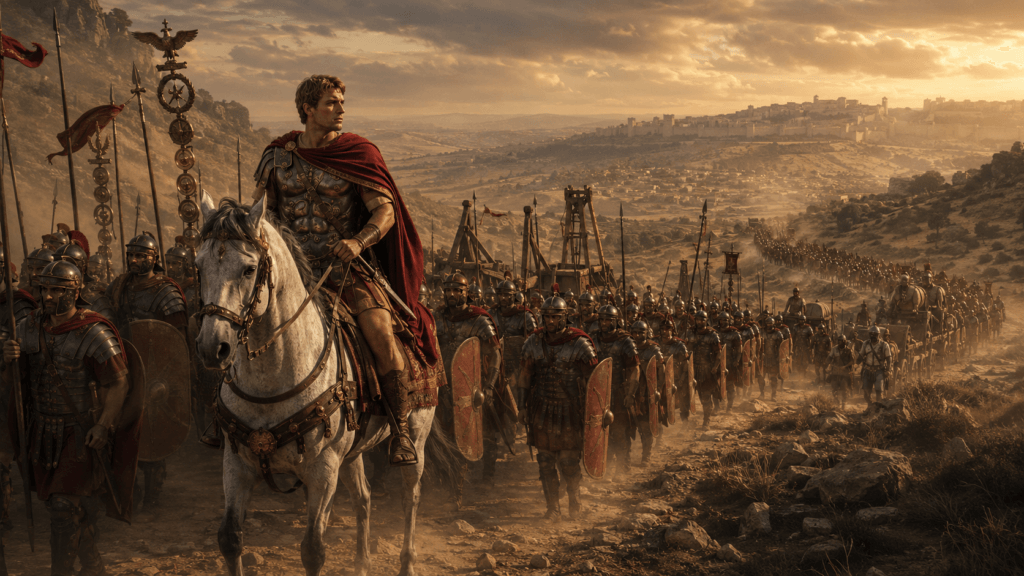
In the spring of 70 AD, the Roman legions arrived at the gates of Jerusalem. Behind them lay a trail of devastation: Galilee subdued, Judea burned, villages and towns reduced to ash. Titus now commanded the campaign, while his father Vespasian had secured his throne in Rome.
The rebel forces had all retreated into the city, and the gates were shut tight. Jerusalem was a formidable fortress that many believed could not be breached. The city was encircled by three massive, interlocking walls that hugged the steep valleys and deep ravines protecting its flanks. It was designed to withstand a multi-year siege. Inside, the granaries were packed with enough food to feed the entire population for years.
Yet, Jerusalem’s greatest enemy was not waiting outside the walls; it was raging within.
The city had become a chaotic battlefield of factions. Different rebel groups led by fiercely competitive warlords such as John of Giscala and Simon bar Giora fought each other for absolute control of the revolution. In a fit of zealot fanaticism, they deliberately burned one another’s vast storehouses of grain, each hoping to force the civilian population into fighting rather than hoarding food. It was an act of tactical suicide. Before a single Roman catapult had been launched, Jerusalem had already destroyed its own lifelines.
The Passover festival had just ended, and hundreds of thousands of pilgrims had poured into the city, unaware they were stepping into a trap. When the Roman army arrived, the gates closed, locking them inside with the rebels.
Titus moved his forces into position, carving down the beautiful orchards, olive groves, and suburban villas outside the city to create a barren, flat wasteland. The legions constructed massive siege camps, setting up their terrifying artillery; the ballistas and catapults that the Jewish historian Josephus described as “launching massive white stones that could crush multiple men at once.”
The iron ring had closed. The siege was underway. The Roman destruction of Jerusalem had begun.
The Roman Destruction of Jerusalem Wall by Wall
Titus wasted no time. The Romans targeted the outer northern fortification, known as the Third Wall, the newest and most vulnerable. Day and night, the rhythmic, thunderous thud of the Roman battering rams echoed through the valleys. The Jewish defenders fought with reckless, terrifying bravery, launching daring nighttime sorties to set fire to the wooden siege towers and cut down the Roman engineers.
.

But Roman discipline was a slow, unstoppable tide. After fifteen days of relentless pounding, the Third Wall cracked and collapsed. The legions poured through, forcing the defenders back behind the Second Wall.
Just five days later, the Second Wall fell. Fighting now spilled into the narrow, labyrinthine streets of the city’s markets. The defenders, knowing every alleyway and rooftop, fought like cornered lions, launching furious counter‑attacks that briefly drove the Romans back out of the breach. But Titus reorganized his lines, cleared the streets, and secured the second line of defense.
Now, only the First Wall, the ancient fortress of Zion, and the colossal, fortified complex of the Temple itself stood between Rome and total victory.
Seeing the immense difficulty of a direct assault on these massive structures, Titus decided to change his strategy. He would starve Jerusalem into submission. To prevent anyone from escaping to find food or water, Titus ordered his army to build a massive wooden wall, a circumvallation, entirely encircling the city. With the legions working like so many ants, the five-mile-long wall was constructed in a staggering three days.
Jerusalem was now completely sealed inside a tomb of its own walls.
The Living Nightmare
With the completion of the wooden wall, a horrific, dark shadow fell over the city. The artificial famine, worsened by the burning of the granaries, took hold with terrifying speed.
The pages of history written by Josephus paint a picture of human suffering that is almost too painful to comprehend. The wealthy were reduced to begging for scraps of hay; others chewed on old leather sandals, belts, and the dung of animals. Shadows of men and women, gaunt and hollow-eyed, drifted through the streets like ghosts. Bands of starving rebels broke into private homes, torturing families to find out if they had hidden a handful of flour or a single loaf of bread.
In the darkness of the night, desperate citizens would slip over the walls to scavenge for wild herbs in the ravines. Most were caught by the Roman patrols. Titus, determined to break the will of the defenders, ordered these captives to be scourged and crucified directly in front of the city walls. At the height of the famine, up to five hundred people were crucified every single day. The hillsides surrounding Jerusalem became a grotesque forest of crosses, until the Romans ran out of wood and could no longer find space for the bodies.
Yet, the inner core of rebels refused to surrender. They viewed any talk of peace as treason against God, believing that at the absolute final moment, the Almighty would intervene with a heavenly host to shatter the Roman legions.
The Day the Heavens Burned
By August, the heat was oppressive, and the stench of death rising from Jerusalem was overpowering. Titus ordered a concentrated assault on the Fortress of Antonia, a massive tower built right against the courtyard of the Temple. After a brutal, bloody night battle, the Romans captured the fortress, giving them direct access to the sacred precincts.
The final hour had arrived. It was the 10th day of the Jewish month of Av, the very same day, centuries earlier, that the Babylonians had destroyed the First Temple of Solomon.
Titus, according to some historical accounts, wanted to preserve the Second Temple. He viewed it as a magnificent monument to Roman architectural appreciation and imperial victory. But in the chaos, fury, and smoke of hand-to-hand combat, human intentions were swallowed by the flames of war.
A Roman soldier, lifted on the shoulders of a comrade, tossed a blazing piece of wood through a golden window into one of the many chambers surrounding the holy sanctuary. The dry wooden paneling and tapestries caught fire instantly.
When the Jewish defenders saw the smoke rising from the holy house, a collective cry of absolute agony tore through the city. They broke off their defensive formations and threw themselves into the swords of the Romans, desperate to extinguish the flames or die alongside their sanctuary.
Titus rushed from his tent, shouting at his soldiers to put out the fire, but his voice was completely drowned out by the deafening roar of the flames, the clashing of swords, and the screams of the dying. The legionaries, consumed by a feral bloodlust and a desire for plunder, ignored their general’s orders. They cut down everyone in their path: priests, elderly men, women, and children, until the steps of the Temple ran deep with torrents of human blood.
The fire spread with terrifying speed. The great golden sheets covering the Temple walls melted, pouring into the cracks of the stone foundations. The roof collapsed in a thunderous roar, sending a mountain of sparks and ash flying high into the Judean night sky. The holy of holies, the place where the divine presence was believed to dwell, was on fire! Soon it was gone!
The Ash and the Echo of the Destruction of Jerusalem
With the Temple destroyed, the remaining spirit of the rebellion crumbled. The upper city held out for a few more weeks, but it was a futile, dying gasp. The Romans systematically hunted down every last pocket of resistance, burning the remaining residential quarters to the ground and leveling the magnificent walls.
Jerusalem, the crown jewel of the ancient Levant, was turned into a desolate field of smoking ash and stone ruins.
The human toll of the tragedy was staggering. Chronicler Josephus estimated that over 1.1 million people perished during the five-month siege, mostly from starvation, disease, and the final slaughter. Nearly 97,000 survivors were bound in chains and taken away as slaves. The young and strong were sent to the deadly gladiator arenas across the Roman empire or forced to work the Egyptian mines.
In 71 AD, Titus returned to Rome in a magnificent triumphal procession. The citizens of Rome cheered as the sacred treasures of the Temple of Jerusalem: the golden Menorah, the Table of Showbread, and the silver trumpets, were paraded through the streets as trophies of war. To immortalize this victory, the Romans built the Arch of Titus, which still stands in Rome today, its stone relief carvings showing the weeping Jewish captives carrying the sacred vessels into exile.
The Legacy of the Roman Destruction of Jerusalem 70 AD
The destruction of Jerusalem was a watershed moment in the history of religion and the ancient Mediterranean world. It reshaped everything permanently.
For Judaism, the loss of the Temple was catastrophic. The ancient sacrificial system centered on the Jerusalem sanctuary could no longer continue. Yet Jewish religious life did not disappear.
In the generations following the catastrophe, teachers and traditions of the emerging rabbinic movement increasingly emphasized Torah study, prayer, religious law, and community life beyond the Temple. Out of this long process developed the foundations of Rabbinic Judaism, which would shape Jewish religious life for centuries.
For the young Christian movement, which began as a sect within Judaism, the catastrophe severed its remaining structural ties to Jerusalem. This displacement accelerated the spread of the early Church into the broader Greco-Roman world, forcing it to establish itself as a distinct, global faith.
Roughly sixty years after its destruction, Emperor Hadrian refounded Jerusalem as the Roman colony Aelia Capitolina. The Roman historian Cassius Dio reports that a temple dedicated to Jupiter was erected in place of the Jewish Temple. The precise location and nature of this Roman sanctuary remain heavily debated. One fact, however, is clear: the Jewish Temple was never rebuilt.
Jerusalem later became an important Christian city under Byzantine rule, but the Temple Mount remained largely abandoned. Centuries passed, and a new religion arrived: Islam.
According to Islamic tradition, the Prophet Muhammad, during his Night Journey and Ascension to Heaven (Isra’ and Mi‘raj), visited the ruins on the Temple Mount. Thus, after Jerusalem came under Muslim rule in the seventh century, the Temple Mount, known in Islam as al-Haram al-Sharif, the Noble Sanctuary, was developed into one of Islam’s most sacred religious precincts.
Also Read: The Horrors Of the 11th Century Crusade
The Dome of the Rock was completed under the Umayyad caliph Abd al-Malik in 691–692 AD. Nearby, the Al-Aqsa Mosque developed under the early Umayyad rulers. The same elevated ground that had once contained the Jewish Temple had now become sacred within another world religion. And so, the consequences of the Roman destruction of Jerusalem in 70 AD continued long after the Roman soldiers had departed.
Today, if you visit the Western Wall in Jerusalem, you can look upon the colossal, ancient stones that survived the unbridled fury of Rome. At their base lie massive, shattered boulders, cracked and blackened by fire, left exactly where they crashed into the ancient street below on that fateful August day in 70 AD. They stand as silent, haunting, and beautiful witnesses to a moment when an empire collided with a holy city, changing the course of the world forever.