
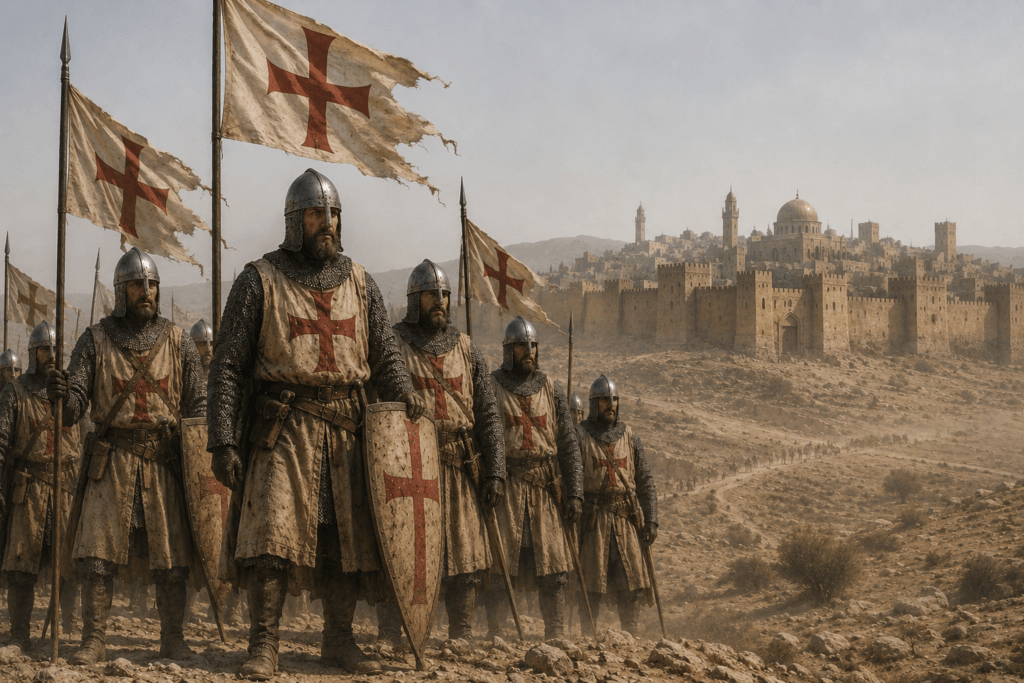
The carnage and destruction unleashed by the European Christians in the 11th century first crusade upon the Islamic lands they invaded, in an apparent bid to avenge the mistreatment of Christian pilgrims, can best be described in one word: Horrific. It did not merely lead to the fall of Jerusalem; it brought about the slaughter of hundreds of thousands of people and the distortion of entire civilized kingdoms.
It all began with the words of one man reverberating across Europe. It was a call to arms, answered by people of all classes marching in their tens of thousands. That man was Pope Urban II, who served as pontiff for eleven years, from March 12, 1088, until his death on July 29, 1099.
The First Crusade: A March of Faith and Fury
In the closing years of the 11th century, Pope Urban II’s call to arms rang out across Europe. He promised remission of sins to Christians who took up the cross and marched east to liberate Jerusalem. Nobles, knights, peasants, artisans, and even women and children responded. What began as a spiritual mission quickly became one of the most violent upheavals of the medieval world.
The Muslim rulers of Anatolia, Syria and the Fatimid lands around Jerusalem were deeply divided by political rivalries. Competing kings, princes, and dynasties struggled for power across the region, leaving them poorly prepared to confront the unexpected armies advancing from the west.
When the first crusaders came marching into these Muslim ruled lands of the east, the locals had no idea who they were or what they were dealing with. At first, they assumed the intruders were Balkan mercenaries in the service of the emperor in Constantinople.
The first Muslim ruler to encounter them was the Seljuk prince Kilij Arslan, who governed northwestern Anatolia from the walled city of Nicaea, about three days’ journey from Constantinople.
On a hot day in the summer of 1096, fast riders arrived at the palace of Prince Arslan with urgent news: a crowd of odd-looking warriors had just entered his territory. They were strange because they were so poorly outfitted. Many did not look like warriors at all, but rather camp followers or beggars trailing a moving host. Almost all wore a cross-shaped patch of red cloth sewn to their garments.
Arslan sent scouts to shadow the group for two days as they moved slowly through his lands. He learned that these people called themselves the Franks. Local Turks and Arabs began to call them al‑Ifranj, “the Franj.”
The intruders openly proclaimed that they had come from a distant land in the west to kill Muslims and conquer the city of Jerusalem, but first they intended to seize Nicaea. Their leader was a talkative fool with a dirty brown beard so long it hung down his chest.
Arslan plotted the route they seemed to be taking, laid an ambush with his army, and crushed them like so many ants. He killed many, captured many more, and drove the rest back into the Byzantine lands from which they had emerged. The victory was so effortless that he gave them no further thought.
What he did not realize was that the “army” he had destroyed was merely the disorganized vanguard of a movement that would plague the Muslim lands along the Mediterranean coast for the next two centuries.
So who were these ill‑equipped soldiers of this chaotic army?
In late November 1095, Pope Urban II visited the city of Clermont in the Auvergne region of central France to attend the Council of Clermont, held at the monastery there. At the conclusion of the event, Pope Urban delivered a stirring address to the French aristocracy. The crowd of visiting bishops, dukes, and knights was so immense that it could not fit inside the cathedral, so a large platform was constructed just outside the eastern gates of the city walls.
While Urban II spoke to the aristocracy, a wandering preacher named Peter the Hermit carried the same message into the streets, squares, and marketplaces.
The core message preached by both Pope Urban II and Peter the Hermit was a powerful, urgent call to arms to liberate Jerusalem from Muslim control, wrapped in the promise of absolute spiritual salvation. They claimed that the Turks were oppressing and killing Eastern Christians and visiting pilgrims, and that it was now God’s will that the Holy Land be freed from their grip.
Throughout that day, Clermont rang with the famous cry: “Deus Vult!” meaning “God wills it!” It was a rallying call that soon swept across France.
Urban had addressed nobles and knights, but it was assumed that any Christian who went crusading could obtain the remission of sins the pope was offering. This allowed Peter the Hermit to recruit from all classes of the poor: peasants, artisans, tradespeople, even women and children.
The new “army” of Peter the Hermit became famously known as the “Crusade of the Poor,” numbering in the tens of thousands. They were brimming with confidence but lacked organization or combat training of any kind. Convinced they were doing God’s work, they believed He would take care of the arrangements and grant them victory. They set out before the formal army organized by the aristocracy was ready. Their first destination was Constantinople, and from there they intended to march on Jerusalem.
It was this same group, tens of thousands of cobblers, butchers, peasants, and the like, that Prince Kilij Arslan encountered and crushed with ease.
Untold Horrors of the 11th Century First Crusade: Fall of Jerusalem
The Knights Arrive
The following year, 1097, the true Crusader armies arrived. These were armored soldiers from France, Normandy, and Flanders; real knights and archers led by battle‑hardened commanders from lands where warfare never ceased. They marched into Anatolia in disciplined columns, prepared to meet any Muslim army.
When news of more Franj marching toward his domain reached Prince Kilij Arslan, he dismissed the threat with a shrug. He believed he could deal with them as easily as he had crushed the last group. He rode out with his army, intending to execute the same ambush.
His first shock came when he saw the new “army.” There were tens of thousands of them in endless columns: some on horseback, many on foot, all marching in disciplined formation with heavy armor unlike anything he had seen before. Not a single man broke rank.
Arslan panicked. He sent his lightly clad horsemen against the vanguard, showering arrows upon the heavy tanks that were the European knights. The Turks picked off some of the Franj foot soldiers, but the knights quickly formed defensive blocks that arrows could not penetrate. Then they pressed forward, slowly, laboriously, yet inexorably.
The knights broke through the center of Arslan’s army and slaughtered his men without mercy. No prisoners were taken. Arslan fled the battlefield and sought refuge behind the walls of his city. The Crusaders pressed on, captured Nicaea, and forced him to seek safety with relatives.
With Nicaea in ruins, the army of knights split up: some marched inland toward Edessa, while others advanced down the Mediterranean coast toward Antioch.
The king of Antioch received the news swiftly and sent a desperate appeal to King Daquq, ruler of Damascus. Daquq wished to help, but he feared the ambitions of his brother Ridwan, ruler of Aleppo, who might seize Damascus if he left with his army.
The king of Mosul also agreed to help and raised an army, but he was drawn into battle with a neighboring ruler who believed he was about to be attacked. Once the misunderstanding was resolved, the king of Mosul marched toward Antioch. He arrived late, only to quarrel with Daquq, who had also arrived late. The desperate king of Antioch failed to manage the situation, and matters spiraled out of control.
The two Muslim kings ended up taking their forces home without helping Antioch at all. The city’s army scattered before the invaders, and the king retreated into the heavily fortified city, shutting the gates tightly.
The Crusader army besieged Antioch, and when it finally fell, they exacted brutal revenge for its resistance. Every soul was put to the sword: men, women, and children, and the city was reduced to ruins.
Having taken Antioch, the knights pressed southward toward a city called Ma’arra.
Ma’arra: Hunger and Horror
That same pattern of rivalry and betrayal played out in city after city across the Muslim world as the Crusaders advanced.
Having heard of what had happened at Nicaea and Antioch, the rulers of Ma’arra were terrified. They too sent urgent messages to nearby cousins and friends, pleading for help. Yet their relatives and neighbors were only too glad to see the wolves from the west descend upon Ma’arra, each hoping to absorb the city for himself once the Franj had passed by. And so Ma’arra was left to face the Crusaders alone.
The Christian knights surrounded the city and laid siege to it. This time, breaching the strong walls took longer. Days turned into weeks, and the months began to pile up. As the inhabitants grew desperate, so too did the knights. The Crusaders had consumed every scrap of food in the vicinity and soon began to starve. No one was going to feed these invaders, and that was the problem with laying a long siege in a strange land.
At last, the leaders of the Crusader army sent a message into the city, assuring the people of Ma’arra that no one would be harmed if they simply opened their gates and surrendered. The city’s leaders decided to comply. But once the starving Crusaders entered Ma’arra, they did more than slaughter. They went on a terrifying rampage that included boiling adult Muslims for soup and skewering Muslim children, roasting them over open fires, and eating them.
Eyewitnesses on both sides, Arab and Frankish, reported cannibalism. Chronicler Radulph of Caen described Crusaders boiling Muslim adults for soup. Albert of Aix, also present at the conquest of Ma’arra, wrote: “Not only did our troops not shrink from eating dead Turks and Saracens; they also ate dogs!”
The implication of Albert’s statement was chilling: Turks were considered less than human. Modern historians debate the scale of this atrocity, but the consistency of the accounts suggests it was real and widespread.
The Betrayals and Rivalries Continue
Amazingly, even after the catastrophe at Ma’arra, the Muslim world could not unite. The ruler of Homs sent the Franj a gift of horses and even offered them advice on which city they might sack next, so long as it was not Homs. The Sunni rulers of Tripoli invited the Franj to make common cause with them against the Shi’a. The knights answered their call, but instead they conquered Tripoli itself.
When the Crusaders first entered the region, the Egyptian vizier al‑Afdal sent a letter to the Byzantine emperor, from whose lands they had come, congratulating him on the “reinforcements” and wishing the Crusaders every success. Egypt had long been locked in a struggle with both the Seljuks and the Abbasids, and al‑Afdal truly believed the newcomers would serve his cause. Only later did it dawn on him that he himself might be in the line of pillage.
The Fall of Jerusalem
After the Franj conquered Antioch, the Fatimid vizier of Egypt, al‑Afdal, wrote to them to ask if there was anything he could do to help their cause. When the Franj moved against Tripoli, al‑Afdal took advantage of the distraction to assert control of Jerusalem in the name of the Fatimid khalifa. He installed his own governor there and assured the Franj that they were welcome to visit Jerusalem anytime as honored pilgrims, promising them protection. The Franj replied that they were not interested in protection but in possession, and that they were coming “with lances raised.”
The Franj marched through largely empty countryside, for their reputation had preceded them. Rural communities fled at their approach, and small towns emptied into larger cities with higher walls for protection.
Jerusalem had the highest and strongest walls in the land, but that did not dissuade the invading army. It was their ultimate goal. After a forty‑day siege that achieved nothing, the Crusaders tried the same trick they had used successfully at Ma’arra. They sent a message to the city’s leaders: “Open the gates, no one will be harmed.”
That trick worked here too. The leaders complied, and Jerusalem threw open its towering gates to the invaders.
Once the city was secured, the Franj indulged in an orgy of killing so drastic that it made all previous carnage seem ordinary. One Crusader, writing about the triumph, described the piling up of heads, hands, and feet in the narrow streets. He called it a “wonderful sight” and spoke of fellow Crusaders riding through heathen blood up to their knees and bridle reins.
Edward Gibbon, the British historian who chronicled the fall of the Roman Empire, declared that the Crusaders killed seventy thousand people within the walls of Jerusalem over the course of two days. Entire households, men, women, and children, were slaughtered simply for being Muslim. Of the city’s Muslims, virtually none survived.
Jerusalem’s Jewish residents took refuge in their central synagogue, praying for deliverance. The Crusaders blockaded the doors and windows and set fire to the building, burning almost the entire Jewish community of Jerusalem in one act.
The city’s native Christians did not fare much better. None of them belonged to the Catholic Church of Rome that had given the Crusaders its backing. Instead, they were members of various Eastern churches such as the Greek, Armenian, Coptic, or Nestorian. The Crusading Franj saw them as schismatics bordering on heresy, and since heretics were considered almost worse than heathens, they confiscated the property of these Eastern Christians and sent them into exile.
Thus ended the First Crusade in the 11th century. Christianity captured the Temple Mount and the Holy Land with the fall of Jerusalem, but at a cost written in blood.
Note on Sources
This article, Untold Horrors of the 11th Century First Crusade: Fall of Jerusalem, synthesizes information from a range of historical records, but its primary foundation is Destiny Disrupted: A History of the World Through Islamic Eyes by Tamim Ansary. Much of the narrative and evidence presented here is drawn directly from primary sources originally documented in Arabic.
Also Read: A story of the fall of Jerusalem to different empires: from the first destruction by the Babylonians to the Romans, the Islamic empires, the First Crusade, right down to the modern Israeli-Palestinian conflict.